





The UAE has positioned itself as a leading AI market, with 42% of organizations now qualifying as AI Leaders, according to a new study. The report also reveals that UAE organizations not only match global peers but are demonstrating exceptional progress in enterprise-wide AI deployment.
The comprehensive study by Boston Consulting Group, which surveyed 200 C-suite executives and assessed 41 digital and AI capabilities across seven industries, shows that 37% of UAE organizations have reached the critical ‘Scaling’ AI maturity stage, signalling a decisive shift from experimental pilots to comprehensive enterprise-wide implementation. With an average AI maturity score of 46, the UAE is positioned at the forefront of its regional peers with only 13% of its organizations scoring at the stagnating level, according to the report titled “Unlocking Potential: How GCC Organizations Can Convert AI Momentum into Value at Scale”.

39% of all GCC organizations now qualify as AI Leaders and 37% of UAE organizations have reached the critical ‘Scaling’ AI maturity stage, marking a shift from pilots to enterprise-wide implementation.
The GCC region sets global standards, with its Public Sector achieving the highest AI maturity level across surveyed markets globally, while Tech, Media and Telecom (TMT) rank first within the GCC.
“The UAE’s emergence as a significantly advanced AI market, with 42% of organizations now qualifying as AI Leaders, is a direct reflection of the nation’s strategic investments in AI infrastructure and unwavering commitment to its AI 2031 Strategy,” Dr. Lars Littig, Managing Director & Partner and ME Leader of the Tech & Digital Advantage practice at Boston Consulting Group, said in a press statement.
“When we see GCC organizations, including in the UAE, delivering significantly higher returns through AI adoption, it validates that these countries’ substantial public and private sector investments are translating into measurable enterprise value. The alignment between national AI ambitions and business outcomes positions the UAE as a regional pioneer, and more significantly as a global benchmark for how strategic AI investments can drive economic transformation,” he added.
Across the broader GCC region, the report demonstrates remarkable progress in closing the AI adoption gap with global markets. According to the report, 39% of all GCC organizations now qualify as AI Leaders, compared to the global average of 40%, representing a fundamental transformation in how regional businesses approach artificial intelligence.
The GCC region demonstrates exceptional AI leadership, with its Public Sector achieving the highest AI maturity levels globally across all surveyed markets. While TMT (Technology, Media, Telecom) continues to lead in AI maturity within the GCC, there is rapid advancement occurring in other critical sectors including Financial Institutions, Health Care, Industrial Goods, and Travel, Cities, and Infrastructure, highlighting the region’s broad-based AI transformation.
The financial impact of AI leadership proves substantial, with AI Leaders across the GCC delivering up to 1.7 times higher total shareholder returns and 1.5 times higher EBIT margins compared to AI Laggards. This performance differential underscores the critical importance of moving beyond pilot programs toward scaled implementation. This success is directly linked to higher AI investment levels – AI Leaders are dedicating 6.2% of their IT budgets to AI in 2025 compared to only 4.2% by Laggards. As AI budgets continue to grow, the value generated by AI Leaders is expected to be 3-5x higher by 2028, not only amplifying their competitive advantage but also significantly widening the performance gap between Leaders and Laggards.
GCC AI Leaders: Pursuing AI-First Models and Unlocking Agentic AI Value
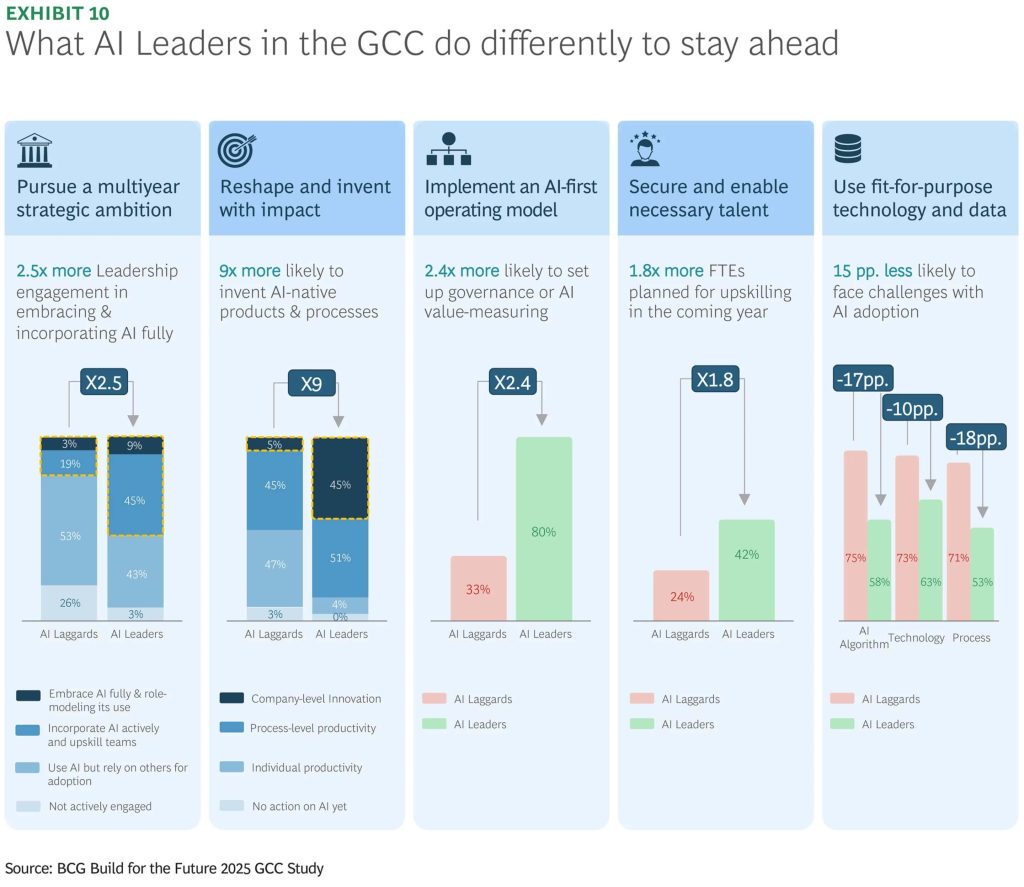
While the GCC has demonstrated advanced digital maturity in recent years, AI maturity has surged by 8 points between 2024 and 2025, now trailing overall digital maturity by just 2 points. The study reveals that successful AI Leaders distinguish themselves through five critical strategic moves: pursuing multi-year strategic ambitions with 2.5 times more leadership engagement than laggards, fundamentally reshaping business processes rather than simply deploying off-the-shelf solutions, implementing AI-first operating models with robust governance frameworks, securing and upskilling talent at 1.8 times the rate of competitors, and building fit-for-purpose technology architectures that reduce adoption challenges by 15%.
Looking toward frontier technologies, 38% of GCC organizations are already experimenting with agentic AI, positioning the region competitively against the global average of 46%. The value generated from agentic AI initiatives, currently at 17%, is projected to double to 29% by 2028, driven by continued experimentation and strategic deployment.
Despite this strong momentum, GCC organizations continue to face barriers to AI adoption, with AI Laggards 18% more likely than AI Leaders to encounter people, organization, process challenges stemming from limited cross-functional collaboration on AI, unclear AI value measurement, misalignment with enterprise strategy, or lack of leadership commitment. AI Laggards are also 17% more likely to face challenges in algorithm implementation, especially around limited access to high-quality data, and 10% more likely to encounter technology constraints, such as security risks and RAI implementation, in addition to a general constraint in the availability of local GPUs, further increasing burden on organizations.
“While the GCC has demonstrated advanced digital maturity over recent years, we’re witnessing remarkable acceleration in AI maturity, marking a fundamental commitment to AI as a core value creator,” added Wietse Bloemzaad, Managing Director & Partner at BCG X, the tech build and design unit of BCG.
“However, the journey ahead requires addressing key organizational challenges: AI Laggards are more likely to face cross-functional collaboration barriers and more likely to struggle with data quality issues.
The promising news is that many GCC organizations are already experimenting with agentic AI, with value generation projected to double by 2028. Success will depend on sustained executive engagement, comprehensive talent development, and the courage to move beyond pilots toward enterprise-wide transformation,” he added.
The report emphasizes that sustained AI leadership requires continued focus on executive engagement, comprehensive talent development, responsible AI governance, and strategic alignment between AI initiatives and broader business objectives. As UAE organizations continue their AI transformation journey, their success in moving from pilot programs to scaled implementation positions them as regional pioneers in the global artificial intelligence evolution.
Read the Full Report
To explore BCG’s complete analysis, read the comprehensive report [here].
