




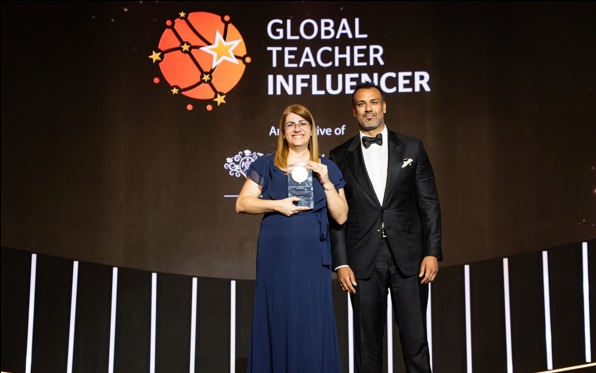
Débora Garofalo, the Global Teacher Prize Ambassador from Brazil, won the first-ever Global Teacher Influencer of the Year at a ceremony in Dubai. The first ever award of its kind was launched by the Varkey Foundation to recognise an exceptional teacher using social media to extend learning beyond the classroom and inspire positive change at scale.
A public-school teacher in São Paulo, Débora received the award from Jay Varkey, Trustee of the Varkey Foundation and Deputy CEO of GEMS Education, at a gala dinner held at Atlantis, The Palm, celebrating outstanding teachers from around the world, according to a media release.

Through her innovative ‘junk robotics’ programme, Débora transforms discarded materials into powerful learning experiences, empowering students, engaging communities, and inspiring educators across Brazil and beyond.
“In the digital age, attention is currency – and you have used that attention to advance learning and inspire others. Through your ‘junk robotics’ programme, which turns discarded materials into education and opportunity, and your uplifting presence online, you are helping students reimagine what is possible, and encouraging educators everywhere to do the same,” said Jay Varkey, Trustee of the Varkey Foundation and Deputy CEO of GEMS Education.
About Débora Garofalo
Débora Garofalo overcame a childhood shaped by poverty and prejudice to pursue a career in education. Before training as a teacher, she worked in human resources within the banking sector in order to fund her studies. This experience gave her valuable insight into the skills students need to succeed in the modern workplace.
When Garofalo began working at a school on the outskirts of São Paulo, near four of the country’s most notorious favelas, she quickly identified a gap in the technology education available to students. The school was under-resourced, and many pupils were affected by their surrounding environment, which was marked by violence, poor sanitation and poverty.
Drawing inspiration from these challenges, Garofalo worked with her students to document local problems through photography. These observations formed the basis of the Junk Robotics, Promoting Sustainability programme. Before launching the initiative, she focused on building her colleagues’ confidence in using technology.
According to Débora Garofalo, “Education is one of the most exciting and rewarding careers there is. I love teaching for the possibility of transforming students’ lives into agents of change for a better world, based on integral and sustainable education with quality and equity.”
She also organised open waste-management classes for the local community, encouraging residents to donate items that would otherwise be discarded. Through the programme, Garofalo teaches the principles of maker culture, guiding students to transform waste materials into prototypes they have imagined, designed and built themselves.
Students initially worked on simple projects before progressing to electronics fundamentals and more advanced robotics, including the use of controllable chips. More than 2,000 students have taken part, creating prototypes ranging from robots and carts to boats and planes. Over 700 kilograms of waste has been repurposed.
The programme has had a measurable impact. Students have strengthened collaborative and interdisciplinary skills, deepened their understanding of electronics and physics, and learned about global citizenship through improving their local environment. It also increased average exam results and reduced school students dropping out.
The initiative has transformed the school’s reputation and influenced technology curricula across São Paulo’s municipal schools. Garofalo also shares her expertise training other teachers through São Paulo Tech Week, national education publications and contributions to national technology-teaching guidelines.
