




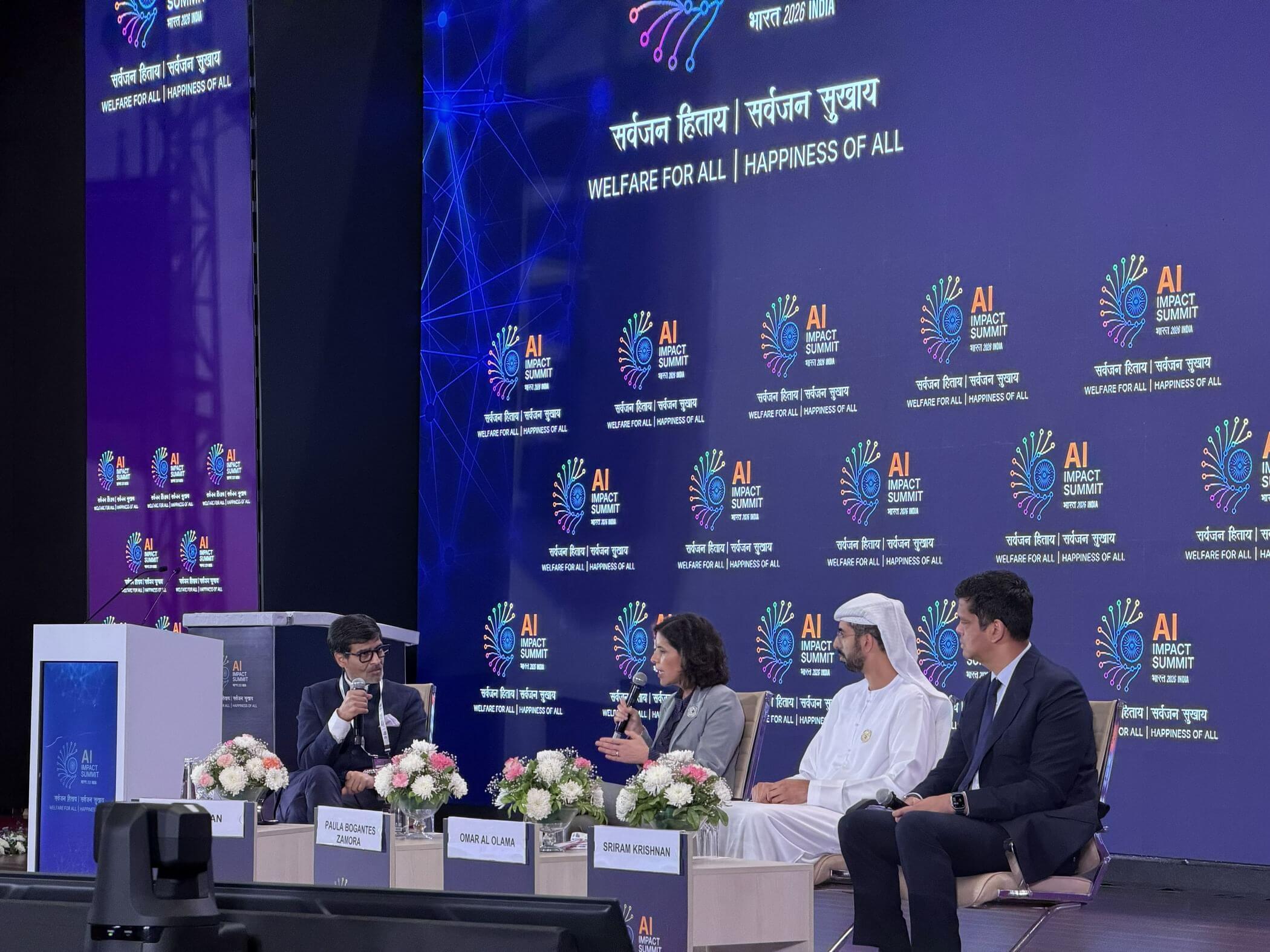
UAE’s early investments in large-scale data centres, cloud partnerships, and sovereign AI platforms enabled the country to be positioned as both a regional and global hub for computing capabilities, Omar Sultan Al Olama, UAE’S Minister of State for Artificial Intelligence, Digital Economy, and Remote Work Applications, said at the AI Impact Summit hosted in New Delhi.
During a session titled “The Global Vision for Artificial Intelligence” as part of the AI Impact Summit, Al Olama noted that computing power has become a strategic global resource and that expanding access to digital infrastructure and participation in AI governance is essential to achieving optimal economic returns from future technologies.

The AI Minister’s emphasis on expanding access to digital infrastructure assumes greater significance in light of the UAE announcing the establishment of a national-scale AI supercomputer in India with 8 exaflops of compute capacity. The system will be delivered by G42, the Abu Dhabi-based global technology group, and Cerebras, makers of the world’s fastest AI inference, in partnership with Mohamed Bin Zayed University of Artificial Intelligence (MBZUAI), and India’s Centre for Development of Advanced Computing (C-DAC).
Designed to meet sovereign security and compliance requirements, the supercomputer will serve as a foundational asset under the India AI Mission.
Al Olama also highlighted that the UAE’s co-chairing of the upcoming summit alongside Swaziland, as well as its hosting of the following edition, represents a strategic opportunity to strengthen international cooperation, ensure continuity in global AI discussions, and align priorities amid the rapid evolution of emerging technologies, according to a press statement.
He reaffirmed the UAE’s commitment to advancing meaningful and effective global dialogue on artificial intelligence, in line with the leadership’s vision to harness advanced technologies in the service of societies and sustainable development.
He emphasized the importance of focusing on practical outcomes and measurable impact when shaping the future of advanced technologies.
The session discussed ways to strengthen the positive global impact of AI, expand its benefits, and build more inclusive and flexible governance frameworks.
Also participating in the session were Paul Bogantes Zamora, Minister of Science, Technology and Telecommunications of the Republic of Costa Rica, and Sriram Krishnan, Senior Policy Advisor at the White House. Participants emphasised the importance of developing a more flexible global governance ecosystem capable of keeping pace with rapid technological advancements and ensuring the inclusion of all countries in shaping the future of AI.
Al Olama underscored the importance of developing more flexible institutional models with the capacity for continuous learning to match the rapid evolution of AI.
He added that the UAE’s vision focuses on embedding AI within a comprehensive infrastructure that serves various sectors. He emphasised that the real challenge lies not only in misuse but also in non-use, noting that the success of AI is measured by how effectively it is integrated into daily life, government services, education, and healthcare. It also depends on accelerating the adoption of smart solutions in vital sectors, strengthening national talent readiness, and building international partnerships that facilitate knowledge transfer and expertise exchange.
Al Olama further stated that, guided by its leadership’s vision, the UAE places great importance on ensuring that investments in AI translate into transformative developments in government efficiency and service quality.
He reaffirmed the need to develop more agile and continuously learning institutional models that keep pace with AI’s rapid evolution while adopting governance frameworks that promote innovation and ensure the responsible and inclusive use of advanced technologies at the international level.
The session also addressed the role of Global South countries in shaping comprehensive AI standards and infrastructure, the importance of regional cooperation to enable access to computing capabilities and large-scale talent development, as well as challenges related to adoption and the economic and social opportunities offered by AI.
Participants discussed ways to foster institutional innovation that enhances the resilience of global AI governance systems and ensures the inclusion of all countries, contributing to sustainable and positive international impact.
The UAE’s participation in the summit, hosted in New Delhi from 16th to 20th February, reflects its ongoing efforts to strengthen international cooperation in artificial intelligence, reinforce its role as a key partner in shaping the future of technology, and build strategic partnerships that support the deployment of AI technologies to advance sustainable development and accelerate innovation across vital sectors.

1 Comment
Hi there, I read your blogs on a regular basis. Your humoristic
style is awesome, keep it up!