




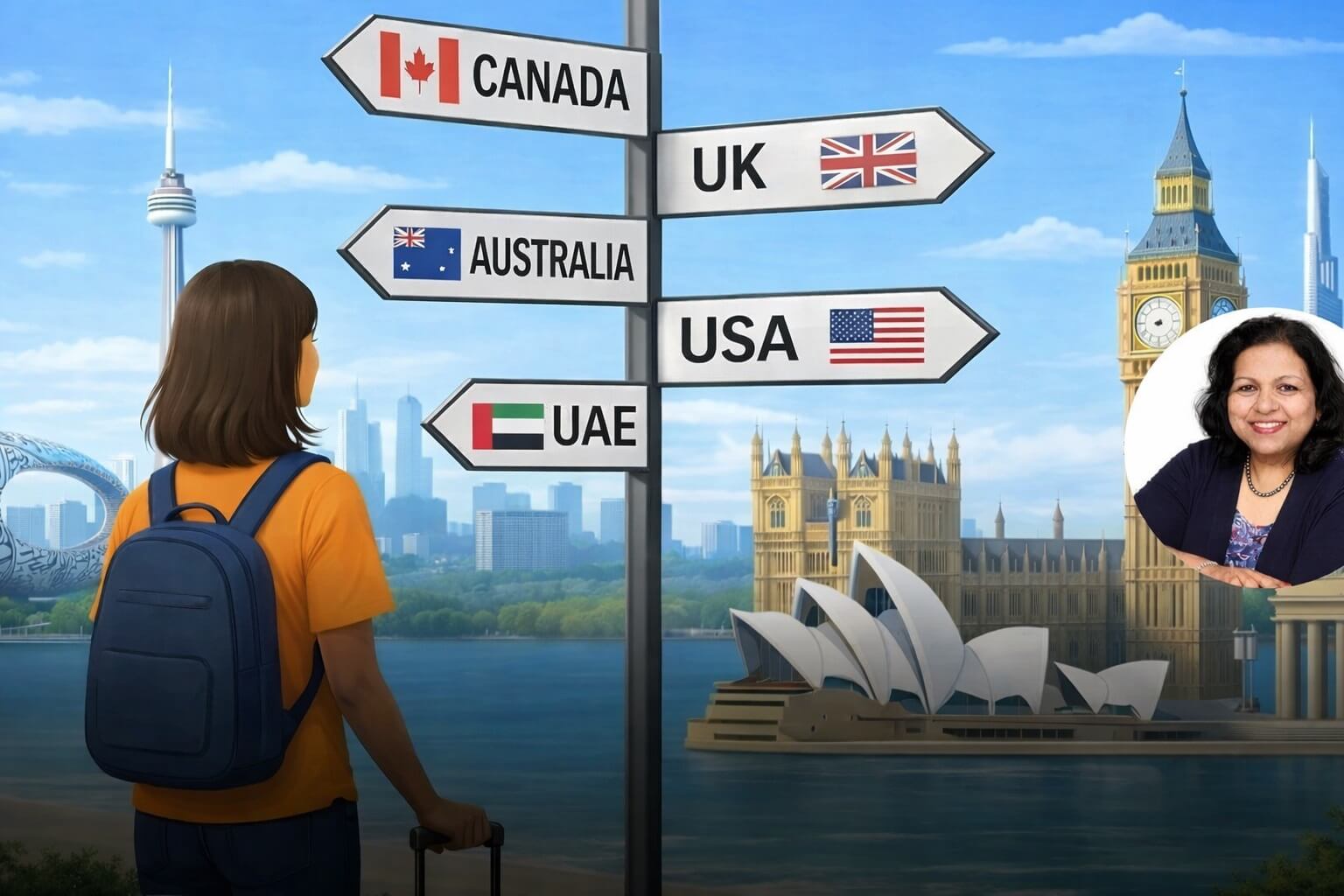
As the US, Canada, Australia and the UK tighten immigration and visa regulations, the often-asked question looming in the minds of 17-year-olds and their parents while making higher educations plans is “To go or not to go abroad for higher studies?”
Until a few years ago, most expat families sent their children either to their home countries or Westward to pursue higher education. With local and international options in the UAE itself becoming increasingly available and also the realisation that the dollar and pound are becoming increasingly dear in the currencies of their home countries, families are forced to rethink their plans. The geopolitical situation and safety concerns are also important considerations.

Parental expectations, peer pressure, and keeping up with the Joneses are all the wrong reasons to pursue a program overseas. Traditional sought-after destinations, the US, UK, Canada and Australia have brought in caps on numbers and introduced stringent visa regulations, making families question their plans.
What Are The Stricter Visa Rule Changes?
In 2025, the UK introduced significant changes to its immigration system. While the government increased the salary and skill requirements for work visas, a major change is also the reduction of the Graduate Route Visa duration. Earlier, international students could stay for up to 24 months after graduation to find work, but this period has now been reduced to 18 months. This reduces the window for students to secure a job in an already saturated market. Additionally, stricter English language requirements and higher financial proof rules have made the visa application process even more challenging.
In the US, the Trump administration has enforced an aggressive immigration and border policy overhaul, increasing costs, expanding scrutiny, and redrawing the entry rules. As a recent Business Standard news article reports, the US has expanded its visa bond program to 38 countries, with applicants now required to post a bond of $5,000 to $15,000 at the visa interview stage itself. This is refunded only if the applicant strictly complies with visa conditions and exits on time. Proposed rules would require applicants to share social media history, submit additional biometric data, and provide proof of ability to pay for medical care during their stay.
Between 2024 and 2025, Canada also enacted a number of policies targeting international students and foreign workers, putting in place tighter regulations for them to gain or extend temporary status. This included a study permit cap for 2025, according to Canadian immigration news website CIC News.
In 2025, Australia hiked the student visa application fee to $2,000 from $1,600. The move followed a 125% fee increase implemented just one year earlier, from $710 to $1,600 as reported by the Economic Times. Australia also in January 2026, reclassified several South Asian countries to the highest-risk category for student visas, imposing stricter documentary requirements and greater scrutiny on applications, as per an NDTV report.
Key Personal Factor To Keep In Mind
In my opinion, apart from the above listed factors, there is one key aspect that warrants serious consideration, and that is the maturity level of the young adult preparing to embark on a new journey. When the young person is not emotionally ready for the challenges of living in a new country, they may find it intensely demanding. The transition may not be smooth, and this could impact the individual’s self-esteem. While making mistakes and learning from them is part of the growing-up process and shapes one’s personality and character, making them strong, some of these mistakes may prove to be costly.
Choices Can Be Emotionally Draining
Young adults who have had limited exposure and a cloistered existence find the transition to university overseas emotionally draining. The plethora of choices one has to make — whether in the classes one needs to enrol in, or the meal plan one needs to opt for — makes it a trying time. Some young adults who are used to having decisions made for them find the choices more of a nightmare than an opportunity to learn and grow. Moreover, some students are not able to handle the freedom they enjoy responsibly. When an academically high-performing student’s grades slip, parents, siblings and as well as the individual are thrown off guard.
As parents, we need to understand that each child is unique and we need to prepare them adequately before they leave the nest. Filling out the forms, crafting the most compelling essays necessary, completing all the pre-requisite tests, ensuring the required funds and getting reasonable scores may help your child secure a place, but staying the course is the challenge. Securing a place in an Ivy League institution may give you bragging rights, but is it the right move for the young adult?
Apart from this, in some educational systems like the North American system, there is a lot of academic freedom and one can pick and choose subjects as per one’s interest and career aspirations, while in others, there is limited flexibility.
We need to factor in this feature while making the decision on where to study. Students who prefer a structured program may find the choices mind-boggling and may keep shifting from program to program, while others may feel confined in a straitjacket.
Individualistic Approach
I had read an interesting book titled ‘American Desi’ long ago. What impressed me was not the writing style but the experiences described by the author. Those situations can still be replicated in the lives of my advisees. The students who think life in America is akin to TV shows or films like Pitch Perfect, Gossip Girl, or shows like Friends, Gilmore Girls, Glee, Big Bang Theory, Community and One Tree Hill will have to think again. Real life and reel life are totally different.
Universities treat students as adults, and the spoon-feeding they are used to in school and at home is no longer ‘a given’. They are expected to seek help when homesick or when they are unable to understand the educational requirements. Many students tell me that it gets totally overwhelming at times. Some students feel that seeking help is a no-no; wherever one chooses to study, seek help when the going seems tough, whether academically or socially. Most institutions have academic advisors who help you set goals, plan your course schedule, pick and drop courses based on career aspirations, making academic life easier to handle.
In parallel, there are student counsellors on campus who help deal with emotional challenges like homesickness, inability to adjust to a roommate, relationship and weight issues, and other psychological issues, to name a few. While seeking such assistance may be a cultural block, it shouldn’t be so. Such support is an integral part of growing up and will facilitate a smoother transition.
Both parents and young adults on the threshold of this momentous decision – ‘to go or not to go’ — have to examine, discuss and seek guidance either from school or outside so that crucial years are not adversely affected.
There is no dearth of local options if your child is ill-prepared for life abroad, be it in your home country or elsewhere. The UAE is home to a wide array of public and international universities offering the same courses that their campuses in the US, UK, India or Australia offer. This option gets your children to earn an international degree in a multicultural setting while staying in the comforts the UAE offers. The decision has to be well thought out, bearing in mind the person’s maturity level, aspirations, needs, financial situation and capabilities.
Rema Menon Vellat is Founder, Director, Counselling Point Training and Development, a KHDA-approved counselling centre based in Dubai.
The views, thoughts, and opinions expressed are solely those of the author.
4 Comments
A thoughtful script relevant for the times.
Life is all about making well thought out, informed and wise choices.
The emotional intelligence that Rema explores ,in context,serves as a true wake -up call.
An effective EI paradigm should look at cultural fitness, adaptability, cross cultural communication capabilities etc within the candidate that should form an integral component while making choices.
Equally important will be to include the “parents-in-loop” at times,even as decision makers.
Maybe counsellor’s themselves can rejig their processes by including a competency based framework in their processes that enables and empowers both aspirants,parents.
The article is informative. The author’s studies the question, from many perspectives and gives wise guidance: practical, student centered and keeping in mind current changes in overseas education policies.
This article offers a timely and balanced perspective on the increasingly complex decision of pursuing higher education abroad. Against the backdrop of tightening visa regulations in the US, UK, Canada and Australia, Rema moves beyond policy changes to foreground a critical yet often overlooked factors such as student maturity and emotional readiness. The piece thoughtfully challenges prestige-driven decisions, highlights the emotional and academic realities of studying overseas and underscores the importance of individualized choices over societal pressure. By also presenting the UAE’s expanding higher education landscape as a credible alternative, the article provides parents and students with a pragmatic, well-rounded framework for decision-making. An insightful and relevant read for families navigating this pivotal transition.
We focus so much on getting students accepted that we rarely pause to ask whether they’re actually ready for the reality they’re walking into. At the same time, travel and exposure to different cultures are a powerful part of becoming a globally aware citizen. Holding both truths matters. Bringing emotional readiness and maturity into the decision feels honest and necessary.